
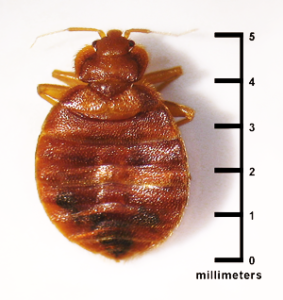
Bedbugs are tiny, parasitic insects that feed on human blood. Due to the increased travel of individuals, the decrease in the use of certain pesticides and pesticide resistance, bedbugs are making a big comeback in Vanderburgh County. While bedbugs have been found to be naturally infected with several blood-borne pathogens, they are not effective vectors of disease and at this time, no infected bedbugs have been found in Vanderburgh County. The primary medical concern is inflammation associated with their bites. The Vanderburgh County Health Department has done numerous inspections and consultations for bedbugs. While we do not currently have a program available for treating homes or businesses for infestations, the Vector Control Division continues to work with and educate businesses and the general public on ways to resolve problems that bedbug infestations create.
Prevention
Follow these steps to protect yourself from bedbugs! Be Vigilant!
- When travelling, wrap your clothes in sealed plastic bags. Black trash bags will work fine but using clear plastic bags will give you the advantage when trying to spot bedbugs.
- Carefully inspect hotel rooms before unpacking your clothes. Bedbugs don’t discriminate. They can be found in the finest hotels, as well as motels you might find on the back roads.
- Check the seams around the mattress and other tight crevices surrounding the bed. Bedbugs love tight cracks and crevices so be thorough. Bedbugs have been found between the cracks of wooden trim, baseboards, and key holes. Others have been found behind the wall plates of electrical outlets.
- Some rooms with bedbug infestations will have a strong “buggy” smell.
- Check for small dark spots along your mattress, sheets and pillows. The spots could be bedbug excrement, smears of blood, molted skin or even eggs.
- Before packing to go home, make sure you re-inspect your clothes and your luggage. The bedbugs may have eluded your earlier inspections.
- Once you get home look over the sealed bag of clothes again. If you missed finding any on your last inspection it is possible they may have settled into the corners of the bag during your trip back home. Remember to thoroughly check the crevices and pockets of your luggage.
- If you haven’t found anything by now but still need some peace of mind, put your clothes and shoes in the dryer at a medium to high setting for 10 to 20 minutes. The heat should kill all life stages including the eggs.
While all this may sound like a lot of work, keep in mind that treating a home for a bedbug infestation is a very involved and time-consuming process requiring the help of a licensed pest control professional. It can be extremely expensive. Take the time to ensure you aren’t bringing bedbugs into your home.
Follow these links for additional information on bedbugs:
If you have questions concerning bedbugs or if you suspect you have bedbugs in your home and need advice, call the Vector Control Office between 8:00 am and 4:30pm, Monday through Friday at 812-435-2400
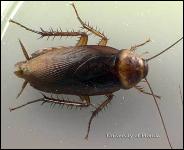
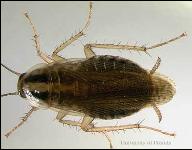
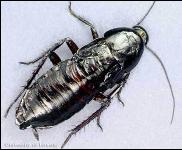
Like rats and mice, cockroaches owe a large part of their success to humans. Wherever you find excesses of organic waste and garbage along with a cool and stable environment, you’re sure to find cockroaches. Roaches can transfer bacteria like Salmonella and Shigella from the unsanitary places they feed to new areas where the bacteria have not yet been introduced; like your toothbrush for instance or the silverware inside your kitchen drawer.
The three most common roaches found in Vanderburgh County are the German cockroach, Oriental cockroach and American cockroach.
Take these steps to prevent your home from being infested with cockroaches.
- Maintain that your home is kept clean
- Sprinkle powdered boric acid around walls, behind cupboards and wherever they may enter your home
- Avoid leaving uncovered food out in the open
- Don’t leave dirty wet pots in the sink
- Insulate pipes to prevent condensation under kitchen units and around the toilet
- Keep your bin clean and empty regularly
- Keep unused areas tidy, avoid a buildup of debris and paper etc.
- Eliminate all sources of moisture / water
- Take action at the first signs of infestation – Keep vigilant
How to Treat a Roach Infestation
For many people there aren’t many other experiences that cause as much revulsion and panic as that first sight of a cockroach crawling across their kitchen counter. Although you may feel violated and angry, before you begin a relentless campaign of chemical warfare, laying traps, gels, and clouds of poisonous gas, it is important to remember what brought the roaches into your home to begin with, and remove those things (listed below) as soon as possible:
- Leftovers
- greasy pans left on the stove
- crumbs and cereal that have fallen between the countertop and the stove
- that bag of soda cans that has been sitting by the back door for a week or two
These things provide roaches with everything they need to live and breed. The first step in ridding your home of roaches is ridding your home of the things that roaches need. Go through your house and clean from top to bottom and remove whatever organic waste, crumbs or trash you can find.
If you are treating your home or apartment without the help of a licensed pest control professional, follow these guidelines for maximum efficiency and safety:
- If you are renting or do not otherwise own your home always get permission from your landlord.
- As with any pesticide, always follow label instructions carefully.
- If you have children or pets do not leave baits out where they have access to them. For any accidental ingestion, call poison control immediately!
- Avoid using “bombing” products as they may cause cockroaches to scatter and retreat to less accessible areas of the home- making future treatments less effective. In addition, insect “bombs” may cause cockroaches to spread to other areas of the house or into adjacent apartments where they had not previously been.
- Products such as pastes and powders are more effective. In most cases roaches will eat the baits and return to the cracks and crevices where they hide to die. There, other cockroaches will actually feed on their carcasses and the baits ingested from the first roach to die will kill them as well.
Follow these links for more information on cockroaches:
For people living in apartment buildings, treating a roach infestation may take time and patience until results are seen. Make sure you remain in contact with your management while treating an ongoing infestation. Do your part by keeping your apartment clean. Protect Yourself! Always do a thorough inspection of a home or apartment before deciding to move.
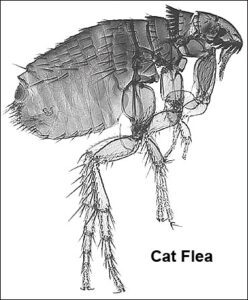
Fleas are of medical importance as vectors. They have been identified as carriers of various rickettsial bacterium that are known to cause diseases like Murine typhus (from the bacteria Rickettsia typhi andRickettsia felis) and the rare Cat flea typhus (from Rickettsia felis). The most historically devastating bacteria carried by fleas is called Yersinia pestis. In humans, it can take the form of pneumonic, septicemic and bubonic plague and is thought to have played a role in some of the highest mortality outbreaks in human history including the Black Death; a plague that devastated about one third of Europe’s population in the twelfth century. Even today, many cases of plague are still reported each year to the World Health Organization. Thankfully, better treatments are available. Medical advancements are providing victims of plague a much better prognosis.
Disease is passed when infected fleas defecate the bacteria while sucking blood. The feces contaminates the bite site and, or any other fresh skin wounds located within range. Occasionally, some cases may follow inhalation of dried infected flea feces.
Fleas may also serve as intermediate hosts for the hymenolepis, dipylidium, and tapeworms.
Due to salivary proteins the bite of a flea can also cause allergic reactions on the skin.
Essential Flea Facts
Fleas don’t bite until they reach adulthood. Though it isn’t unusual to find them in the carpet, couch cushions or bed sheets, adult fleas will spend the majority of their time on the animal or animals on which they feed. They lay their eggs there too (up to 50 a day). Most of the eggs will fall off of your pet into the carpet, or any of the other favorite places your pet enjoys hanging out. It’s for this reason that it is imperative that you treat both your pet and your pet’s environment. After hatching, tiny worm-like larvae emerge and hide themselves deep in carpet fibers, mattress crevices and underneath the cushions of your furniture where they’ll feed on the accumulated feces (dried blood) of the adult fleas. The larvae transform into pupae inside a silk-like cocoon and will remain there for 2 to 4 weeks. This cocoon is resistant to insecticides making follow up treatments and persistent vacuuming necessary even after fleas are no longer found.
Ridding Your Home of Fleas
If you have pets, the most important step in ridding your home of fleas is to focus your attention on treating the pet’s environment. Neglecting to do so can cause you to miss the highest concentrations of the flea population, i.e., the eggs, larvae and pupae.
If you keep your pet indoors, even if it is only occasionally, begin treatment there.
The following tips are from Mike Potter, the Extension Entomologist from the University of Kentucky College of Agriculture and whose website on flea control can be found here.
Before treatment, the pet owner should:
- Remove all toys, clothing, and stored items from floors, under beds, and in closets. This step is essential so that all areas will be accessible for treatment.
- Remove pet food and water dishes, cover fish tanks, and disconnect their aerators.
- Wash, dry-clean or destroy all pet bedding.
- Vacuum! — vacuuming removes many of the eggs, larvae and pupae developing within the home. Vacuuming also stimulates pre-adult fleas to emerge sooner from their insecticide-resistant cocoons, thus hastening their contact with insecticide residues in the carpet. By raising the nap of the carpet, vacuuming improves the insecticide’s penetration down to the base of the carpet fibers where the developing fleas live. Vacuum thoroughly, especially in areas where pets rest or sleep. Don’t forget to vacuum along edges of rooms and beneath furniture, cushions, beds, and throw rugs. After vacuuming, seal the vacuum bag in a garbage bag and discard it in an outdoor trash container.
Insecticide Application
Once fleas become established in a home, insecticides are almost always needed to control them. Always read and follow label directions on the insecticide container. Other than the person performing the application, people and pets should be out of the house during treatment. People and pets should also remain off treated surfaces until the spray has dried. This may take several hours, depending on carpet type, ventilation and method of application. Opening windows and running the fan or air conditioner after treatment will enhance drying and minimize odor.
Treating Your Pets
Your veterinarian offers a number of effective products to treat your pets for fleas and ticks. Pills, collars and “spot-ons” come in varying degrees of potency depending on your pet’s size or breed. Over the counter alternatives may be less potent but can be just as effective. Always read and follow label directions when using any pesticide.
If you have question you can call the Vector Control office Monday-Friday, 8:00 am until 4:30 pm at 812-435-2400.
For more information on fleas and how to rid your home and pets of fleas, follow the links below.
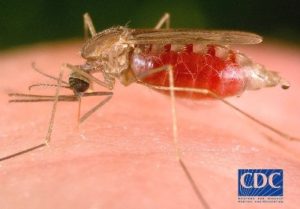
Annoying and relentless biters, female mosquitoes have a knack for spoiling the time we spend outdoors. From early spring to late fall, our outdoor activities put us in direct contact with mosquitoes. Different species of mosquito feed at varying times of the day and evening, assuring our risk of exposure to these seemingly ravenous pests. When a female mosquito bites, she injects a salivary fluid into the skin of her host. If that mosquito has previously bit an infected bird, it is possible it can infect its host with a number of different viruses. While not all mosquitoes in Vanderburgh County are disease vectors, some species are.
The Vanderburgh County Health Department’s Vector Control Program works to reduce populations of both nuisance and disease carrying mosquitoes throughout the county.
This page is dedicated to providing you with the information you’ll need to keep you and your family safe this mosquito season.
Viruses that mosquitoes have been found to carry in the United States:
- Eastern equine encephalitis
- Japanese encephalitis
- La Crosse encephalitis
- St. Louis encephalitis
- West Nile virus
The First Steps in Prevention: Surveillance/Habitat Elimination
Take these steps to make sure you aren’t raising future generations of mosquitoes!
| Check your yard for standing water. Mosquitoes need water to reproduce. They lay their eggs either directly in water or on the dry vegetation in and around areas where, after a rain event, water accumulates. Depending on environmental conditions the eggs can hatch within 24 hours. The mosquito will spend its first few days in the water developing from larvae to pupa until finally it is ready to emerge as an adult. Within a few hours the newly emerged adult will be ready to find a blood source. If there are locations or objects around your property where water can collect and stand you may be raising mosquitoes. Keep in mind that mosquitoes don’t necessarily need a lot of water to develop. Even a discarded soda can fill with water and easily produce up to 20 dozen larvae. Keep containers like buckets or tires turned over or stored out of the weather to prevent them from collecting water where mosquitoes can develop. | 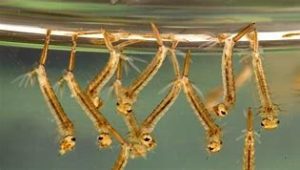 The image above from the CDC shows how mosquito larvae breathe by attaching themselves to the surface of the water. Mosquito larvae vary in color, shape and size. |
The following list provides some prime mosquito breeding habitats. Take the necessary precautions to ensure that these areas do not provide mosquitoes a place to breed in your yard.
- Old tires: All old tires without rims should be stored out of the weather. Tires collecting water are a prime breeding site for the aggressive Asian Tiger mosquito. If you have unused tires in your yard, remember that Vanderburgh County usually has a tire amnesty day twice a year.
- Clogged gutters: Make an effort to clean your gutters in the spring and late fall.
- Flower pots: Some flower pots sit in a “plate” to prevent water from trickling from the actual container. These “plates” are commonly overlooked as places where mosquitoes breed.
- Buckets and other yard “clutter” that may hold water like trash and debris or children’s toys are places where we commonly find mosquito larvae. Be mindful of any clutter in your yard that could collect water and take the necessary steps to remove all of these potential breeding receptacles.
- Low grassy areas: Vector Control has a large list of areas that it maintains throughout Vanderburgh County. Areas where water collects and stands for more than 24 hours are treated with larvicide oil applications and are rechecked until the standing water from each site has dried. If you know of an area where water stands for more than 24 hours after a rain event, please contact the Vanderburgh County Health Department.
- Bird baths: Change the water in your bird baths daily.
- Unmaintained swimming pools especially the smaller plastic “kiddie pools” are excellent places for mosquitoes to breed. Make sure they are stored out of the weather when they aren’t being used. For full sized pools that are not being used, make sure the pool is covered with a tarp and that any water in the pool has been treated with the appropriate chemicals. Even if it is vacant, do not attempt to treat a neighbor’s unmaintained pool with chemicals. Contact the Vanderburgh Health Department and we will take the appropriate steps to resolve any issues we find.
- Inflatable pools: Once deflated, these pools are still capable of holding water. Take steps to ensure that once these pools are no longer in use, they are disposed of properly.
- Garden Ponds: If you own a small garden-type water fountain or pond, make sure it is being maintained. Ensure that the water is continuously circulated or add fish to your garden pond to minimize the risk of your pond harboring mosquitoes. If you, for whatever reason, are unable to maintain your pond, there are products available, that when used properly, can be used to treat any mosquito larvae your pond may be attracting. These products are usually available where you purchase any other water garden materials. As with all pesticides, follow directions on the label to ensure safety and efficiency.
- Trash Receptacles: Make sure trash cans are covered. Punch holes in their bottoms to prevent them from filling with water.
- Eaves Troughs: Keep all natural drainage areas in your yard clear of leaves or grass clippings. Flowing water is not a successful environment for mosquito larvae. Do not attempt to fill low areas or drainage ditches with grass clippings or other organic material. Doing so only enhances the environment for mosquito larvae to thrive.
Remember, if you have areas of standing (non-flowing), stagnant water on your property and you think you may be raising mosquitoes; please call the Vector Control office to set up an appointment. We will inspect, and in some cases treat, areas of standing water where mosquito larvae are present.
Insect Repellant and Other Methods of Personal Protection: Recommended Steps You Can Take to Avoid Being Bitten
- Avoid peak mosquito feeding periods, at dawn and at dusk.
- Wear light colored clothing.
- Avoid perfumes, cologne and scented lotions when going outside.
- Avoid mosquito habitat.
- If possible, use yellow lighting for outdoor fixtures instead of fluorescent.
- Wear long pants and long sleeves when outdoors.
- Use insect repellants containing DEET or Picaridin when outside. (Be sure to follow label directions). Products containing DEET should not be used on infants <2 months of age.
- Avoid the use of gimmick products like sonic emitters and insect zappers. While the zapping light traps do kill some adult mosquitoes, they also kill many other beneficial insects.
The following personal protection information is taken directly from the Center for Disease Control:
Q. How does mosquito repellent work?
A. Female mosquitoes bite people and animals because they need the protein found in blood to help develop their eggs. Mosquitoes are attracted to people by skin odors and carbon dioxide from breath. The active ingredients in repellents make the person unattractive for feeding. Repellents do not kill mosquitoes. Repellents are effective only at short distances from the treated surface, so you may still see mosquitoes flying nearby.
Active Ingredients (Types of Insect Repellent)
Q. Which mosquito repellents work best?
A. CDC recommends using products that have been shown to work in scientific trials and that contain active ingredients which have been registered with the US Environmental Protection Agency (EPA) for use as insect repellents on skin or clothing. When EPA registers a repellent, they evaluate the product for efficacy and potential effects on human beings and the environment. EPA registration means that EPA does not expect a product, when used according to the instructions on the label, to cause unreasonable adverse effects to human health or the environment.
Of the active ingredients registered with the EPA, CDC believes that two have demonstrated a higher degree of efficacy in the peer-reviewed, scientific literature (see CDC’s insect repellent page). Products containing these active ingredients typically provide longer-lasting protection than others:
- DEET (N,N-diethyl-m-toluamide)
- Picaridin (KBR 3023)
Oil of lemon eucalyptus [active ingredient: p-menthane 3,8-diol (PMD)], a plant-based repellent, is also registered with EPA. In two recent scientific publications, oil of lemon eucalyptus was found to provide protection similar to repellents with low concentrations of DEET. Products containing Oil of Lemon Eucalyptus should not be used on infants <3 years of age.
Remember, if you have areas of standing, stagnant water on your property and you think you may be raising mosquitoes; please call the Vector Control office to set up an appointment. We will inspect, and in some cases treat, areas of standing water where mosquito larvae are present.
For more information about mosquitoes and mosquito borne illnesses, visit these websites:
The Building Commission releases rodent bait to property owners and tenants.
- You must bring a government issued identification card to the Building Commission office,
located in room 310 of the Civic Center. - You will be required to complete a Bait Release form.
If you have questions concerning the rodent bait program, please call 812-436-7885 or email the Building Commission here.
More information on rodents can be found on the following web sites:
Ticks are arachnids like scorpions, spiders and mites. They’re most active in the warmer months of April until September but year-round vigilance is always recommended. While feeding, ticks can pass infections from one host to the next including humans. If you or your child is bitten by a tick, note the date and time when the tick was found and the area where the tick was most likely picked up. To prevent any secondary infections, we recommend you keep the bite area cleaned with rubbing alcohol, an iodine scrub, or soap and water. For the next three to four weeks, you should be watchful for any developing rash (usually shaped like a bull’s eye, but any rash anywhere on your body should be noted) or if you experience fever or any other unexplained illness, consult with your physician immediately.
The Vanderburgh County Health Department is not currently testing ticks for disease; however, you are welcome to bring ticks in for identification, or you can refer to the CDC’s tick identification guide (located below). If you choose to bring a tick in for identification, please ensure the specimen is sealed in a clear, plastic container. What Diseases Are Ticks Known to Carry?
| 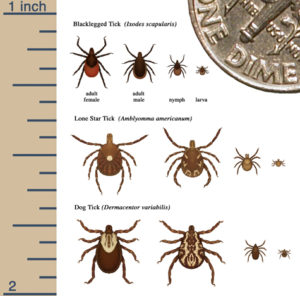 | |
| (From the U.S. Centers for Disease Control and Prevention) |
Avoid Direct Contact with Ticks
- Avoid wooded areas and fields where high grasses are located.
- If hiking, keep to the center of trails.
- If ticks are present in vegetation along the edge of your property, insecticides labeled for control of ticks can be applied to small areas of high weeds that cannot be mowed. Always follow directions when using pesticides.
- After being outside, check your pets thoroughly to ensure they do not carry any ticks into your home.
Repel Ticks with DEET or Permethrin
- Use repellents that contain 20% or more DEET (N, N-diethyl-m-toluamide) on the exposed skin for protection that lasts up to several hours. Always follow product instructions. Parents should apply this product to their children, avoiding hands, eyes, and mouth.
- Use products that contain permethrin on clothing. Treat clothing and gear, such as boots, pants, socks and tents. It remains protective through several washings. Pre-treated clothing is available and remains protective for up to 70 washings.
- Other repellents registered by the Environmental Protection Agency (EPA) may be found at http://cfpub.epa.gov/oppref/insect/.
Find and Remove Ticks from Your Body
- Bathe or shower as soon as possible after coming indoors (preferably within two hours) to wash off and more easily find ticks that are crawling on you.
- Conduct a full-body tick check using a hand-held or full-length mirror to view all parts of your body upon return from tick-infested areas. Parents should check their children for ticks under the arms, in and around the ears, inside the belly button, behind the knees, between the legs, around the waist, and especially in their hair.
- Examine gear and pets. Ticks can ride into the home on clothing and pets, then attach to a person later, so carefully examine pets, coats, and day packs. Tumble clothes in a dryer on high heat for an hour to kill remaining ticks.
How to Properly Remove a Tick
The following information and images are taken directly from the Center for Disease Control’s webpage which can be found here.
Tick Removal
If you find a tick attached to your skin, there’s no need to panic. There are several tick removal devices on the market, but a plain set of fine-tipped tweezers will remove a tick quite effectively.
- Use fine-tipped tweezers to grasp the tick as close to the skin’s surface as possible.
- Pull upward with steady, even pressure. Don’t twist or jerk the tick; this can cause the mouthparts to break off and remain in the skin. If this happens, remove the mouthparts with tweezers. If you are unable to remove the mouth easily with clean tweezers, leave it alone and let the skin heal.
- After removing the tick, thoroughly clean the bite area and your hands with rubbing alcohol, an iodine scrub, or soap and water.
Avoid folklore remedies such as “painting” the tick with nail polish or petroleum jelly or using heat to make the tick detach from the skin. Your goal is to remove the tick as quickly as possible-not waiting for it to detach.
If you develop a rash or fever within several weeks of removing a tick, see your doctor immediately. Be prepared to provide information such as when the bite occurred, and where you most likely acquired the tick.
If you have questions about ticks or if you have a tick you’d like identified call the Vector Control office at 812-435-2400 to schedule an appointment.
Follow these links to learn more about ticks: